
Teaching
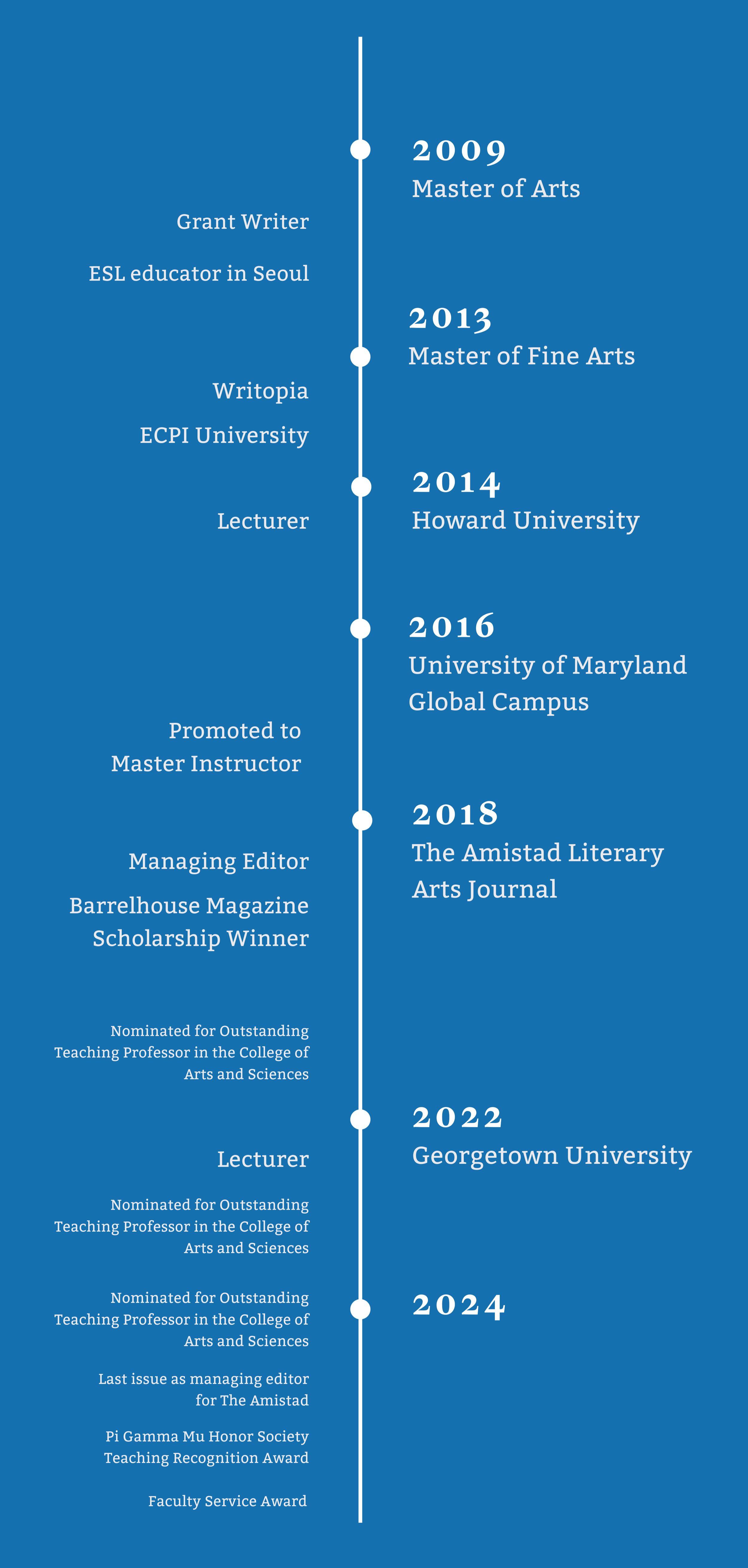
HISTORY
PHILOSOPHY
As an educator, it is my duty to prepare students for success during and after our shared time in the classroom. I believe this is best achieved by fostering a collaborative environment and by allowing students to connect their own experiences to formal learning. This process best mirrors two theories: Jerome Bruner’s constructionist theory and Paulo Freire’s ideologies surrounding critical consciousness. The constructionist model, or learning based upon current/ past knowledge, and Freire’s staunch belief in knowledge as not only political, but a space for action and reflection gives me insight and charge. With these guiding principles, I have come to see that students steadfastly rooted in communication, shared experience, and dialogue – both internal and external – gain maturiy and close cognitive gaps. This ancedotal and measurable success tells me that classroom discussion, hands-on activity, written feedback, and performance prepares students for earnest advancement.
I came to these philosophies through unique teaching experiences with various age ranges (three-year olds to non-traditional adults), learning platforms (higher education, elementary education, writing centers, and tutoring), and diverse social environments (a Jewish day school, a South Korean hagwon, and an HBCU). Starting as a lower elementary teacher, I became adept at managing the classroom environment and the importance of individual interaction combined with positive behavioral support(s). In addition to delivering instruction on a large scale, I assessed specific student needs and created strategies to help each succeed. The lessons learned in these unique environments, as well as theoretical research on composition theory, harness my current classroom pedagogy, more specifically at Howard University as a writing instructor.
Perhaps, more than any other setting, students at Howard prove that collaborative learning spaces breed a sense of ownership. Through dialogue, empathetic connections are established and multifaceted viewpoints are shared. By allowing students to lead discussion, present their research, and discuss their lives, they feel seen and heard. This communal exchange allows for healthy debate and learning. This exchange also allows everyone to bring their unique insights to various topics. Learning blossoms when nurturing a student’s voice and opinion.
These types of nourishing exchanges allow students to see material through many perspectives; at the same time, it allows them to question content and meaning. Following Freire, students should and need to reflect upon their place in society. Similarly, getting students to consider large-scale issues long after they leave university is essential. Rather than only concerning myself with students’ grades, my goal is to help them develop strategies to interpret content and meaning in both global and rhetorical contexts. By working on these skills, students can apply these methods to their own life. Ultimately, they learn to ignore the surface, and put stock in questioning, researching, and acting.
My time at Howard University has allowed critical conversations to exist in a unique space. The personal narratives of primarily black students are woven with complex social and theoretical issues, intercontinental history, current affairs, and social change. In my classroom we discuss how such a person can contribute to local, academic, and social communities. The end goal is collective consideration mixed with personal reflection ultimately leading to action.
Students invest in the “personal” through current events, challenging topics, reflective journaling about their writing process, and challenging surface level assumptions. By promoting cognition through comfortable classroom atmosphere built on collaborative learning, students question their patterns and roles. No student is the same, and each has an irreplaceable voice. I am confident my philosophy ensures every voice can be heard in and beyond the university.
COURSES TAUGHT
-
ENG 002 – Freshman English
ENG 099 – Introduction to Writing
ENG 101 – Introduction to Composition
ENG 102 – Expository Writing & Literacy Studies
ENG 110 – College Composition
ENG 120 – Advanced Composition
ENGL 191 – Introduction to Rhetorical and Analytical Writing
ENGW 103 - Hybrid Forms: Writing Beyond Boundaries
ENGW 105 – Reflective Portfolio Writing
WRIT 1150 – The Rhetoric of Style
WRIT 1150 – Writing and Culture
WRTG 111 – Academic Writing I
WRTG 112 – Academic Writing II
WRTG 391 – Advanced Research Writing
-
ENGW 103 - Research-Based Creative Nonfiction
ENG 117 – Introduction to Creative Writing: Fiction
ENGL 289 – Topics in Literature and Writing: Creative Writing and Publishing The Amistad
ENGL 2800 – Introduction to Creative Writing
Writopia - Creative Writing Workshops for Kids
Various Creative Writing Workshops
-
CAP 480 – Arts and Sciences Capstone
HUM 205 – Culture and Diversity
-
ENG 003 – Deconstructing the New Black Hero
ENG 201 – Reading and Writing about Texts
ENGL 184 – Introduction to Literature
ENGW 103 – Exploring Black Political Activism of the 1960s in Relation to Today
ENGW 105 – Analyzing the Portfolio of Ta-Nehisi Coates
ENGW 105 – Reflections on James Baldwin
WRIT 1150 – Comics and Culture
-
Elementary Courses in General Education
FOR 110 – Essentials for Success
Tutoring - Private
Writing Center Tutor
WRTG 394 – Advanced Business Writing